
Belly Dance for Beginners: What to Know Before You Start.
A journey to discover feminity, music and movement beauty.

Have you ever watched an Oriental dancer lose herself in the music, moving with elegance, grace and ease? Have you ever wondered whether you could learn to dance like that, too?
The answer is yes, absolutely!
Belly dance, also known as Oriental dance, is a captivating art form that lets you explore movement, develop body awareness and discover a world of music and culture with a rich history.
And the best part? You don’t need any previous experience to get started.
Whether you’re in your twenties, forties, sixties or beyond, Oriental dance can give you a wonderful way to make time for yourself.
Let’s look at what you need to know before your first class.
1. What is Belly Dance?

Belly dance is one of the best-known dance forms of the Arab world.
The name belly dance, commonly used in the West, echoes the French expression danse du ventre. The term is often associated with accounts by French soldiers and travellers during Napoleon Bonaparte’s Egyptian campaign at the end of the eighteenth century. It draws attention to the movements of the abdomen and hips that those observers noticed in Egyptian dance.
The name puts the focus on the belly, but there’s much more to this art form.
One of its roots is Raqs Baladi, a popular Egyptian social dance closely associated with Cairo and still practised today. Its movements carry the expressive and symbolic traditions of Egyptian dance. Raqs Sharqi developed as a stage form, bringing a new style of performance and costume that often left the midriff bare and accentuated the neckline. It remains a prominent part of Egypt’s performance scene.
The term belly dance has become part of popular culture, but the dance involves the whole body. The hips, torso, arms, hands and head all play a part in expressing the music.
Its beauty comes from the way technique, musicality, interpretation and emotion come together.
2. Can I start belly dancing if I’ve never danced before?
Of course!
One of the great things about Oriental dance is that you can start without having studied dance before.
In a beginner class, you learn the basic movements gradually, starting with posture, coordination and an awareness of how your body moves.
You don’t need to be particularly flexible or athletic, or to have a natural sense of rhythm. You can develop these skills over time through study and practice.
Give yourself time to learn. Every woman has her own body, her own rhythm and her own way of expressing herself through dance.
3. Do I need a certain body type to belly dance?

Absolutely not.
One of the most common misconceptions about belly dance is that you need a certain body type to do it. There’s no ideal body type for Oriental dance.
Women of different ages, body types and backgrounds can learn the technique and develop their own expressive style.
Dance is an opportunity to get to know your body, listen to it and appreciate what it can do.
That’s why I see Oriental dance as a form of self-discovery. Each student can learn to move more freely and feel more at ease in her own body.
4. What are the benefits of belly dance?

Oriental dance brings together physical movement, focus and artistic expression. With regular practice at a pace that suits you, it can help you:
Improve coordination by combining different movements.
Develop body awareness by learning how to move and control different parts of your body.
Build mobility and fluidity through exercises that gradually increase in difficulty.
Develop a sense of rhythm by listening to the patterns in the music.
Practise memory and concentration by learning sequences and combinations.
Support emotional wellbeing by making time for an activity that is both creative and enjoyable.
There’s another benefit I especially value: rediscovering the joy of moving without feeling judged.
Dancing can be a moment that’s entirely yours, away from the responsibilities and rush of everyday life.
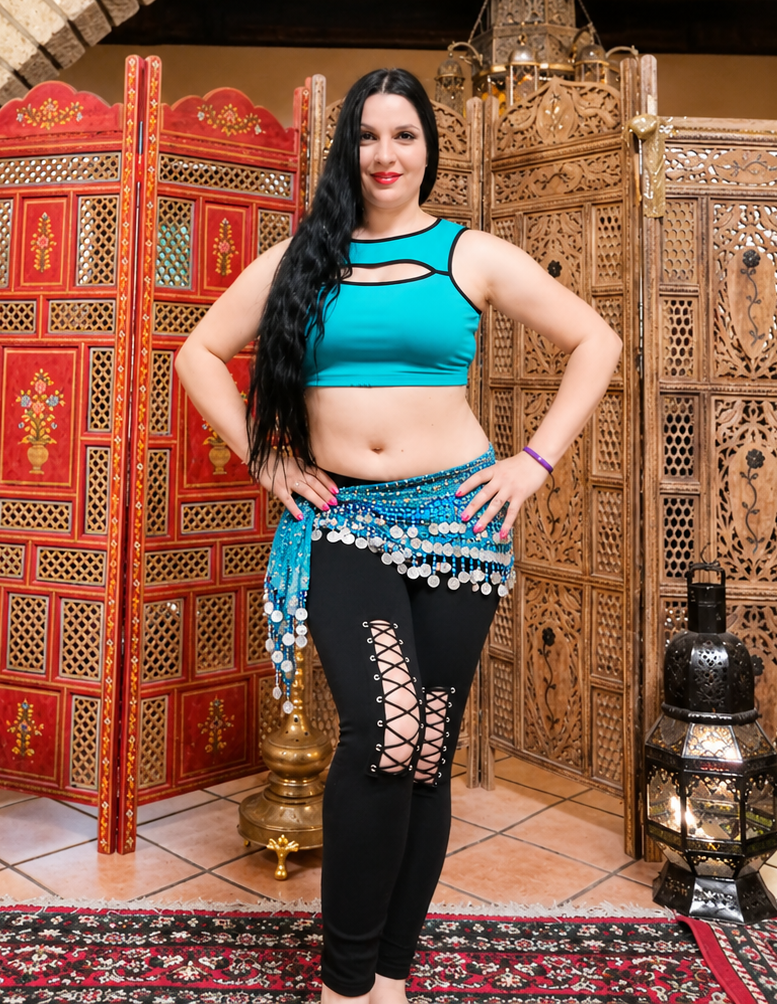
5. What should I wear to my first belly dance class?
You don’t need to buy a professional costume. To get started, bring a few simple, comfortable items:
Leggings or loose trousers that let you move freely.
A comfortable T-shirt or top.
A scarf to tie around your hips so you can feel your hip movements more clearly.
Soft dance shoes if your teacher recommends them. Otherwise, you can dance barefoot.
Your own yoga mat for the warm-up on the floor at the start of class.
You don’t need a traditional coin scarf for your first class. We’ll introduce it later, along with other accessories such as a veil.
Most of all, you don’t have to show your belly. Wear whatever makes you feel comfortable.
6. What will I learn in my first few classes?
A good beginner course in Oriental dance starts with solid foundations. Here’s what you can usually expect:
Posture and alignmentYou’ll learn how to distribute your weight, find good alignment and prepare your body to move.
Basic hip movementsYou’ll practise hip sways, accents, circles and simple patterns, learning to distinguish one movement from another.
Torso and arm movementsYou’ll explore isolations, undulations and ways to coordinate your arms and torso to bring grace to your dancing.
Rhythm and musicalityYou’ll listen to Arabic music, begin to recognise some of its rhythms and discover how movement responds to sound.
Short dance sequencesYou’ll connect movements in simple combinations that help develop memory, coordination and expression.
Over time, the technique starts to feel more natural, leaving you more room to interpret the music in your own way.
7. How long does it take to learn belly dance?

Everyone learns at a different pace. It depends on how often you attend class, how much you practise on your own and what kinds of movement you’ve done before.
In your first few lessons, you can already begin to learn some basic movements and enjoy the feeling of dancing to the music.
Technical confidence takes time. Oriental dance is a vast art form, and even professional dancers keep learning and refining their skills throughout their careers.
Give yourself time to fall in love with the process.
8. Can I start belly dancing after 40 or 50?

Yes! There’s no upper age limit for starting Oriental dance.
Many women discover it as adults, at a time when they want to make more space for themselves. A class suited to your level can give you a welcoming place to learn without pressure.
As with any physical activity, listen to your body and adapt your practice to your own needs.
Dance is for anyone who wants to dance, at any age.
9. How do I choose a good belly dance class?

Choosing the right teacher matters. Oriental dance is an artistic language shaped by tradition, music, technique and interpretation.
Look for a course that offers:
A gradual approach to learning technique.
Attention to posture and each student’s needs.
Practice in listening to music and recognising rhythms.
An introduction to the dance’s history and cultural roots.
A welcoming space where every student can express herself freely.
A good teacher shows you how to listen to the music and turn what you hear into movement.
10. Where can I take belly dance classes in Rome and the Castelli Romani?

If you’d like to get started, I’d love to welcome you to my Oriental dance classes in Rome’s Colli Albani neighbourhood and Marino, in the Castelli Romani.
I’m Maryem Bent Anis, an Italian-Tunisian dancer, Oriental dance teacher and artist.
My journey began with my family and cultural ties to the Arab world. It has grown through years of study, research, teaching and performance.
In my classes, I share the technique of Oriental dance alongside my love of Arabic music, the culture it comes from and the freedom to express yourself through movement.
Belly Dance Classes in Rome – Colli Albani
Classes take place at One Way Gym, Via Ariccia 19, Rome, near Colli Albani station on Metro Line A.
Belly Dance Classes in Marino – Castelli Romani
Classes take place at Centro Taus, Via Costa Caselle 15, Marino, within easy reach of Grottaferrata, Castel Gandolfo, Albano Laziale and Frascati.
The first step? Give yourself a chance to try.
You don’t need to know how to dance.
You don’t need a perfect body.
You don’t have anything to prove.
Give yourself the chance to discover something new. Let the music guide you and see where it takes you. You might surprise yourself.
Sometimes all it takes is a melody, a movement and a little courage to reconnect with a part of yourself that’s been waiting to be heard.
Make time for yourself, one dance step at a time.
I look forward to dancing with you!
Maryem Bent Anis
Information and registration
WhatsApp: +39 339 727 8629
Official website: www.maryem.art
Comments